Showing posts with label tempo. Show all posts

Friday, February 7, 2014

Don Gato


I love being a student teacher mentor because it keeps my curriculum fresh. As my student teachers explore books and materials from my shelf, they discover songs and poems that I have overlooked for years! Last fall, I had my first student teacher for just 8 weeks. Ms. Morrison discovered the Mexican song "Don Gato" in an old textbook. (Grade 3, Music Connection from Silver Burdett & Ginn)  The book suggested students play the chord roots on Orff instruments along with the recording. However, the chord progression was very challenging for many of the students in the short amount of time provided in the lesson. Also, the instruments were so loud it was very difficult for the students to hear the recording and stay with the tempo of the song. Although the lesson didn't go as well as planned, it was a great teachable moment and allowed for Ms. Morrison to practice self-reflection.

This fall, I had the pleasure of mentoring a second student teacher for an entire semester! Ms. Moreman and I cotaught "Don Gato" with some modifications. The original goal of the lesson was to teach about a ballad. The students would still learn about a ballad, but we decided the main focus of the lesson would be chord building. We had just studied the order of the musical alphabet with some relay races and small group games. (Click here to learn more about the staff games!) We wanted to reinforce this concept because some students were still struggling to remember that A follows G. We also decided to use Boomwhackers instead of barred instruments. The Boomwhackers were much more quiet and did not overpower the recording. The students LOVED  this lesson!

Lesson Sequence 

  1. Discuss the term "ballad". Play one verse of "Don Gato" at a time, asking students what is happening in the story and how the plot has changed. I display the words of each verse on the flip chart as we discuss it.
  2. Display the slide with "tempo" and "dynamics" definitions. Ask the students when they hear these musical elements change and how that was related to the story. (The music gets quieter and slower when Don Gato dies and louder and faster when he comes back to life.)
  3. Review the definition of "harmony." Using a xylophone, demonstrate how to build a chord by skipping every other letter. Give the students a starting letter and ask them to spell the chord and build a triad (diatonic). Play each triad on the xylophone and ask them if it sounded major or minor.
  4. Divide the class into 4 groups, one for each chord in the song (D minor, C major, G minor, and A major). Each student will play one or two Boomwhackers from their chord.  Ask  to play with a steady beat and then ask them only to play when you point to their chord grouping on the board.
  5. Display the harmonic progression to accompany the song.  Practice the progression in tempo without the music and then try to accompany the recording, remembering to change tempo and dynamics on the appropriate verse. 
  6. We also tried to sing the song without the recording so we could hear the Boomwhackers more clearly. I was able to conduct the groups and Ms. Moreman changed the slides to display the lyrics. (this could easily be a job for a student helper) The students' favorite part, by far, was singing "meow, meow, meow" in each verse.

Music Recording

I used the textbook CD to accompany the Grade 3 Music Connection by Silver Burdett & Ginn. If you don't have that textbook series, you can use the audio from this YouTube video.


How Many Boomwhackers Do You Need?


When I taught this lesson  I used 5 sets of diatonic Boomwhackers and 6 Octavator caps. The small black rectangles represent the octavator caps which lower the pitch of the Boomwhacker a full octave. When teaching the lesson, I challenged the students to guess what the small black rectangles would represent. There was at least one student in each class who remembered the Octavator Caps from a previous lesson.


If you only have diatonic Boomwhackers, the A major and G minor chords will feature only the root and the fifth of the chord. 

If you have 24 kids in a class, each group would have about 6 kids. So, you would need:
  • Group 1: DFA, 2 of each pitch
  • Group 2: CEG, 2 of each pitch
  • Group 3: GD, 3 of each pitch, 3 Octavator caps on G 
  • Group 4: AE, 3 of each pitch, 3 Octavator caps on A
I have since purchased 2 sets of chromatic Boomwhackers. So, next year I plan on using this set up:
  • Group 1: DFA, 2 of each pitch
  • Group 2: CEG, 2 of each pitch
  • Group 3: GBbD, 2 of each pitch with 4 Octavator caps on G and Bb
  • Group 4: AC#E, 2 of each pitch, with 2 Octavator caps on A
 For this set up, you would only need 4 diatonic sets, 2 chromatic sets, and 6 Octavator Caps.

I also purchased a set of bass diatonic Boomwhackers and plan rewarding one student in each group with the big Bass Boomwhackers. These sound best when you place an Octavator cap on them, hold them vertical, and tap the cap end on the carpeted floor.

 ***In the uploaded flipchart, both versions are available (with and without Bb and C#). You can choose which version to use according to your available resources.


Friday, November 15, 2013

Buzz, Ollie, Luke, and Lori

I see my students once a week for 50 minutes. Yes, even kindergarten! There have been some recent conversations on a Facebook Music Teacher board concerning lesson planning when you have kindergarteners for an extended time. This post will share a few of my tips when lesson planning for kindergarten.

I usually try to plan 3 different activities for my kindergarten classes in order to keep their attention and minimize discipline issues.  I include a variety of activities in each day which could include a listening activity or book, singing, instruments, movement (locomotor or nonlocomotor), dramatic play, dancing, play party games, etc. Today, I'm going to share a few books that are written with a specific goal to introduce a musical concept. I may begin a lesson with a book or use it as a transition activity between songs or games.

The first books I purchased were the Buzz and Ollie books.
There are 3 books in this series.  In Buzz and Ollie's Steady Beat Adventure, the kids travel to their grandparents' house and discover lots of environmental sounds that make a steady beat like windshield wipers, a clock, and a dripping faucet. In Buzz and Ollie's High, Low Adventure, the kids get lost in the forest and meet lots of animals giving them directions. But, they were told they should only follow the sounds that are low to find their way back home. The animals with high sounds are trying to trick them. In Buzz and Ollie's Loud, Soft Adventure, the kids hear quiet sounds like a baby bear snoring and then loud sounds like a bear roaring. The symbols for piano and forte also appear in the book.
I bought the hard cover books about six or seven years ago from westmusic.com for 14.95 each. Unfortunately, these books are currently out of print. However, you may find some used copies online for a variety of prices.

Another great book that is still in print is Luke & Lori's Musical Journey. You can find it at westmusic.com for $19.95.


This book is a collection of 4 short stories. They could be read all together or you could read each story by itself. Luke and Lori, the main characters in the book, introduce the basic elements of music as they take a musical journey and meet different people who teach them about long and short sounds, tempo, dynamics, and high and low sounds. 

As I said before, I try to plan a variety of activities for kindergarten classes to prevent discipline issues. Even if I cannot plan a movement activity in my lesson, sometimes simply changing locations in the room can help keep the wiggles to a minimum. Most of the time, my students are sitting around the edge of my solid blue square carpet facing the boards. When I have a book to share with the students, they get to sit on my alphabet carpet and face the back of the room near my desk and keyboard. The rule is only one person per square and everyone must be sitting criss-cross applesauce on their bottom so everyone behind them can see. Below, you can see a picture of my carpets. (For a full tour of my classroom, check out this previous post.) .

My students love these stories. I try to include one story every few weeks throughout the entire year. They would be great for a substitute teacher as well! Do you have any of these books? If so, share your ideas and opinions below!


Coda: An afterthought regarding the carpets. The solid blue rug and the alphabet carpet are actually touching because the older kids are too big for one carpet and must sit around the edges of both carpets


Saturday, October 27, 2012

Halloween Music Door

We always have a trick or treat night where the students get to parade through the hallways in the costumes and trick or treat. Each teacher sits outside their door giving away treats. This year, out PTO decided to give prizes (gift cards to a store of out choice) for the teacher with he best decorated door and the best costume. Well, thanks to Pinterest, everyone had really cute doors. So, I knew I had to up my game plan. My door was going to be more than a decoration. I designed a door that enhanced my instruction.


I always use Halloween as a chance to discuss minor harmony. I used the door during instruction to also discuss several other musical elements. 

Recipe for Spooky Music 


Minor Harmony (dissonant chords make your skin crawl)

Unusual Sound Effects (usually from the percussion family)


Subito Fortissimo (suddenly loud)
Musical example: "Skin and Bones"

Accellerando (gradually get faster)
Musical example: "Hall of the Mountain King"

Melody Goes Higher (raising the pitch level increases suspense) 
Musical example: Jaws theme


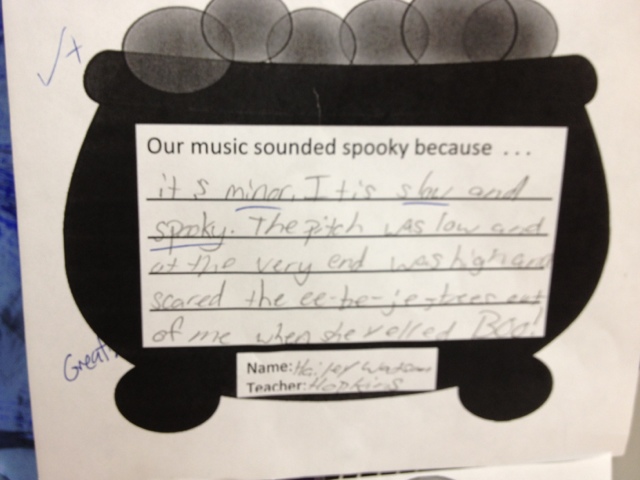
Students in grades 2-5 completed an exit slip before they left class. They completed a sentence "Our music sounded spooky because . . ." I picked a few papers from each class to frame my door. Here are a few student responses


The winners of the door decorating contest have not yet been announced. I'll let you know if my time and effort is rewarded.

Monday, June 11, 2012

We Love Phil Tulga!

My students and I love the website of Phil Tulga! If you are not already familiar with his site, here is a brief introduction.
He has many music games that integrate language arts, math, and science. He also has several different instructions to make homemade instruments.


Here are a few of our favorite games:

Musical Fraction Bars


This activity describes how to measure and make your own musical tubes similar to Boomwhackers. The interactive game allows students to compose with the colored bars and even play back their music in various tempi. The students can create harmony by stacking colored tubes. The colors of these tubes match the colors of the Boomwhackers; so, after composing a song, students can use Boomwhackers to play it themselves. There are also several preloaded songs students can choose to start with and then alter to make a variation. The students can create a song and then email it to a friend, parent, or teacher! This game provides endless fun!

Cucumber Pickle Machine


My students LOVE the Cucumber Pickle Machine. I don't know if it is the silly face made by the machine or just their love of pickles, but they could spend the entire class playing this game if I would let them! This game explores mixed meter with the 3-syllable word "cucumber" and the 2-syllable word "pickle". The white cucumbers and pickles are silences. Phil has also listed several popular meters for the students to create on the machine: rhuma, flamenco, clave, heartbeat, conga, short bell, fanga, samba, and the most popular "Mission Impossible."

Unifix Drum Machine


This game allows students to compose layered rhythms. The ostinatos repeat on a loop but you can also change the tempo. You can control which part you hear by turning each on or off by one easy click. You change the color of each square by clicking the square: blue=low, red=high, yellow=silence. There are several patterns available for the students to choose from or they can start from scratch and create their own. The students can see how there are 4 cubes grouped together. This can represent 4 beats in a measure or 4 subdivisions of the beat. After exploring this game on the interactive white board, give the students real Unifix cubes to create their own rhythms! 

There are many more activities available on Phil Tulga's site! Go, explore, and share your favorite Phil Tulga activity!

Thursday, June 7, 2012

All About Voices


In the previous post, I talked about using voice cards as visual aids. In this post, I will explain a couple activities that use the visual aids. At the bottom of the post, you can download the pdf and print them for free!

Name Game

For 1st grade and kindergarten, I always review voices on their first music class of the year when we are doing name games. We do simple echos:

Teacher:  "My name is Mrs. Dennis"
Class: "Her name is Mrs. Dennis"
Student: "My name is Joshua."
Class: "His name is Joshua."

thekinderkid.blogspot.com
After we go once around the circle learning names, I introduce the voices with the cards. (I also tie this to our school-wide voice level system. I do not have a picture of our voice level posters, but I found a similar one from The Kinder Kid. Our numbers and levels are the same, but we don't have the cute clipart.) When the students understand the voice levels, we get to go around the circle again saying our name to the beat, but this time each student secretly picks a voice (whisper, speaking, calling, singing). We must echo using the same voice and then I ask the class what type of voice they used.

Voice level zero

For the past 3 years, since I have been relating these voices to the voice level number, the kids always ask to say their names with voice level zero. We now call it "Magic Lips". Anytime I want the kids to move their lips without making a sound, I ask them to use Magic Lips. I actually use this with all grade levels. I usually ask for Magic Lips when I had the kids patting a rhythm while saying a poem and then I want to hear their patting by itself. I also ask for Magic Lips when students are using Curwen hand signs and I want them to stop singing and focus on the pitch levels.

Acka Backa

I use the voice cards often in repetitive games, just to break up the monotony. One example is an elimination game: "Acka Backa." Here is the poem if you are not familiar with it:

Acka Backa, soda cracker
Acka Backa, boo
Acka Backa, soda cracker
Out goes you!

There are many variations to the words; you may know a different version, but this is how we play. This is a simple elimination game. To prepare the students, I have them stand in a circle and pass a ball around to the steady beat. We first practice passing to the beat at different tempos. I usually hold a buffalo drum and stand inside the circle showing where the ball should be. If the ball passes up the drum, they know they are going too fast. When they are focused on the beat, we introduce the poem and the rules. The last person to hold the ball on "you" leaves the circle. The student gets to go to my chair where I have the voice cards laying face down. They pick a card to tell us which voice to use next and then they get to mix them up again for the next person. Elimination games are always tough for the kids who always want to win, but going to select a card seems to ease the disappointment that they are out of the game.

Free Printable:

Voice Cards (whisper, speaking, calling, singing)

I suggest printing them on white cardstock and laminating them.


Monday, June 4, 2012

Assessing Music With a Line-Up Song


I learned this song from my KTIP mentor, Alicia Franklin, during my first year teaching. I introduce this song in kindergarten and we sing it everyday when we line up. 


I sing the first note as a fermata and hold it until every student is joining in and doing their job to line up. There are hand motions to accompany the song. On the first word "my", we raise our hands in the air (this makes it easy to see who is actually paying attention in line and ready to sing the song). Then, we do what the song says. 

           Phrase 1: place hands back
           
Phrase 2: exaggerate good posture
           
Phrase 3: take 2 fingers, point at eyes then 

                 straight ahead
           
Phrase 4: hands return behind back
           
Phrase 5: zip lips, pretend to put in pocket, 

                 hands return behind back, mouth is closed

When the kids get to 1st grade, the song only makes guest appearances when we need help remembering how to line up or when I want to see if they can apply the musical concept we just learned.

Using the Song For Assessment


Assess Tempo

If we learned about tempo that day, we may choose a tempo (largo, moderato, allegro) and sing our song accordingly. They may also get to line up to a tempo. I may ask them to show me allegro feet, largo feet, or moderato feet to line up. Depending on how much time is left in class, I may do this individually  or in small groups. If I do it individually, I usually take notes in my grade book for a performance assessment. Older students can watch the conductor and respond to accelerandos and ritardandos.

Assess Dynamics

If we learned about dynamics that day, we may choose a dynamic level for the entire song (piano, mezzopiano, mezzoforte, forte) or watch the conductor to see how the dynamic levels change throughout the song. Older students can usually remember a pattern to assign different dynamic levels to each phrase. Similar to the game discussed above, sometimes we can line up with piano feet (tiptoeing) or forte feet (stomping). Again, depending on the time remaining in class, this is either done individually or in small groups and is sometimes used as a performance assessment.

Assess Melody

If we learned about melodic direction that day, we may use our hand levels to show the melodic contour. (That's why I like the simple shape of this melody going upward then downward.) If we discussed pitch, we may sing it in a high key or a low key.

Assess Harmony

If we learned about minor harmony (Halloween), we may choose to change the song to minor and make it sound spooky. (All the kids LOVE this!)

Assess Timbre

If we discussed different types of voices (speaking, whisper, calling, singing), we may choose to use different voices to use throughout the entire song, or we may change our voices for each phrase. I also have voice cards that I can hold up and show the students what to change to. (View the next post for printable voice cards.)

Assess Rhythm

If we discussed rhythm (long and short sounds), we may sing the song exaggerating note lengths in tenuto or staccato style. If we discussed a fermata, we may choose one or two words to have a fermata and sing those words really long.

Coda

These are just a few examples of how I use our line up song for assessment. Sometimes, instead of telling them how to sing it, I let the kids pick a variation to sing. Again, I only sing it every time with kindergarten; and they never get tired of singing it. It only appears occasionally with older grades. It appears sometimes as a warning to those not ready for the hall: "Do we HAVE to revisit kindergarten and sing the line-up song?" Their behavior is quickly corrected. Many older students LOVE the line up song, as it brings nostalgia from kindergarten. 

Even if you have a line-up song already in place, you could probably use these assessment strategies with your song as well. I would love to hear other ideas to use line-up songs as assessment tools. If you have some more ideas, please comment below.

Monday, May 28, 2012

Free Online Metronomes


For several years, a pendulum metronome was on my classroom wishlist; I wanted students to be able to see the arm moving side to side with the beat. But, with our dwindling budget, I could never justify spending that much money on a visual aid. The classic Wittner is currently on sale on westmusic.com for $57.20.

In 2010, I started searching online for interactive metronomes. Most of the metronomes I found were digital. They were perfectly fine tools for musicians to use for practicing, but none provided the moving arm that I wanted the students to see. 
www.metronomeonline.com
www.webmetronome.com
advanced.bestmetronome.com
  I was looking at the suggested resource sites from my district's technology department and saw the online-stopwatch site. They have a lot of neat tools for counting time, etc. So, I emailed a suggestion that they add a metronome and they were very interested. They sent me emails as they were developing the tool and I got to provide input throughout the design process. It felt amazing to make a suggestion and have someone actually listen. 


www.online-stopwatch.com/metronome

This metronome has 6 different sounds to choose from. It has a volume control so you don't have to change the master volume of your entire computer. Down in the corner the Italian tempo terms are listed next to the beats per minute (one of my suggestions). This is also available for free download! They even wrote a little message at the top giving me credit for the suggestion!


If you are not familiar with online-stopwatch.com, you should check it out. There are many varieties of timers and counters. A few are available for free download. I have the basic timer as a shortcut on my computer desktop for quick and easy access. Many teachers use these timers everyday for timed activities. There are many varieties you can change them often so the students do not get bored.

http://www.timrylands.com/2011/03/17/clocks/

Although I did not find this during my searches in 2010 (it likely was not in existence then), today I found another mechanical metronome that features a movable pendulum arm. This metronome looks more life-like. When you first start the metronome you even hear sounds as you wind it up. However, the background is black and that makes it very hard to see on the projector in my classroom. Also, it only features one clicking sound, whereas the online-stopwatch metronome has six sounds to choose from. You may choose which one works best for your classroom.
simple.bestmetronome.com

The most important lesson I learned during this entire process: "ask and ye shall receive." I was frustrated that I could not find the resource I wanted. I thought other teachers may have the same frustrations, so I made a suggestion and someone actually listened! How amazing! It would be a wonderful world if every concern and suggestion were answered so swiftly. I realize this world is in my fantasy, but you never know who is willing to listen if you don't even bother to ask! I hope you can find some of these free online tools helpful. If you can't find a tool to meet your needs, don't be afraid to email your suggestions! Someone might actually listen!

THANK YOU, 
ONLINE-STOPWATCH.COM, 
FOR LISTENING!