Showing posts with label Boomwhackers. Show all posts

Wednesday, October 18, 2017

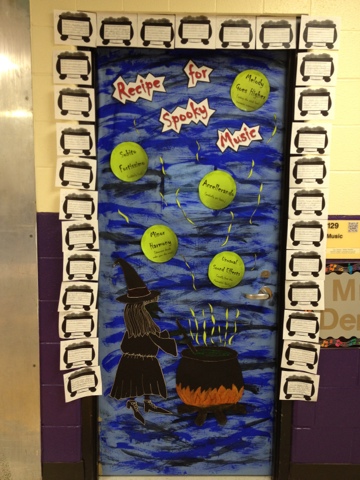
Interactive Halloween Door

Our PTO is throwing a Halloween Door Decorating Contest again this year. I won the contest a few years ago and decided to step it up again. Here is a link to my posts if you missed them.


My door is inspired by Beethoven's 5th Symphony. "Fate Is Knocking At Our Door..."


Beethoven appears as the grim reaper. The music for the fate motive is printed and color coded to match the Boomwhackers. The Boomwhackers are held in xylo-tote and large binder clips. The clips are hung with 3M Command Hooks.
The door is a hit with students. I hear them stopping by before school, afterschool, and even sneaking during the day to come play Beethoven's 5th. I'm sure I may be driving my neighboring teachers crazy, but it makes me smile every time.

Here's a video of the door in action:


Monday, August 22, 2016

Boomwhacker Storage Upgrade


In the past, I have posted about my Boomwhacker storage, but have acquire many more sets since then. Here is a look at my previous Boomwhacker Storage.


I created these dividers out of hand drum boxes. I would slide the box right into my wall of cabinets.


Since I have purchased more diatonic, bass, and chromatic sets, I needed a new storage system.


For the diatonic treble sets, I took an adjustable shelf off my short metal bookcase. I went to Big Lots armed with a post-it with measurements of the height, width, and depth of my shelf and the width of one Boomwhacker or 2 side by side. I took some measuring tape with me to the store. After much deliberation, I purchased 8 vertical file holders which cost $2.50 each. At first, I was going to spray paint them to match the Boomwhackers, but getting custom colors would be expensive very quickly. So, I decided to make some labels.


This shelf used to store textbooks which I rarely ever use. Those books are now in my wooden cabinet and are available if needed. These Boomwhackers are now easily accessible and visually pleasing.

To store the bass and chromatic sets, I used grocery bag holders from IKEA. These were only $1.99 each! They are mounted with 3M Velcro strips. I have left room to grow my collection and plan on purchasing some more bass and chromatic sets this year.


I love how this useless space behind the door now serves a purpose! My custodian has sent a work order for maintenance to install a doorstop on the tile to prevent the door from squishing the Boomwhackers. I'll add a picture when it is installed.

If you would like a copy of my Boomwhacker labels, I have added them to my store on Teachers Pay Teachers. They include labels for treble, bass, and chromatic sets. There is an option for labels with solfa hand signs or with staff notation. There are bass labels with single notes, or with combinations of notes like you see above in my picture. This set has lots of options for you to customize for your own Boomwhacker collection!

Saturday, January 31, 2015

Snowman Chords and "Let It Go"


Do you still have Frozen Fever? Most of my students, and some teachers, are still obsessed with Frozen!  (Theresa, I'm calling you out!) I saw a post by Dyan Robson using snowmen to build chords on a staff. I immediately saw an opportunity to teach a lesson using music from the movie Frozen. Her blog post can be found at this link.


A snowman is the perfect visual for a triad chord in root position. I created an interactive door display to get students excited about the lesson. I reused some decorations from my daughter's Frozen-themed birthday party. I traced Olaf onto a poster board using the projector and painted his outline. (At the party, he was used for a game of "Pin the Nose On Olaf".) The door engages the students to learn about the chords. They can quiz themselves to match the letter names to the snowman chords. They lift the flaps to check their answers.


I taught the chord lesson to my 5th graders. They reviewed note names by labeling the chords.
We reviewed the concept of major and minor by listening to some chords used in the song "Let It Go." The students played the chords on Boomwhackers, but I also played the chords on the piano to make it easier for them to hear. Even though I displayed the chords in root position, I added octavator caps to A flats, B flats, and B naturals.


The students were seated in a horseshoe shape and I distributed the Boomwhackers in order chromatically. The students were responsible for looking for their pitch name. Those students with chromatic Boomwhackers knew to look for both sharp and flat equivalencies. We practiced the chord progressions and then played along with "Let It Go" via a YouTube video.


I had to remind the students not to sing along unless they already had the song memorized. Often they would be busy trying to read the lyrics and missed their turn to play the harmony.

At the end of class, students completed an exit slip naming the pitches of some snowman chords.


My interactive flipchart is available for download on Promethean Planet. If you do not have an Activboard, the still images from those slides are available on Teachers Pay Teachers and included in a combo pack with the bulletin board printables and exit slip assessment.

Saturday, March 22, 2014

Minions Invade the Music Room!!!


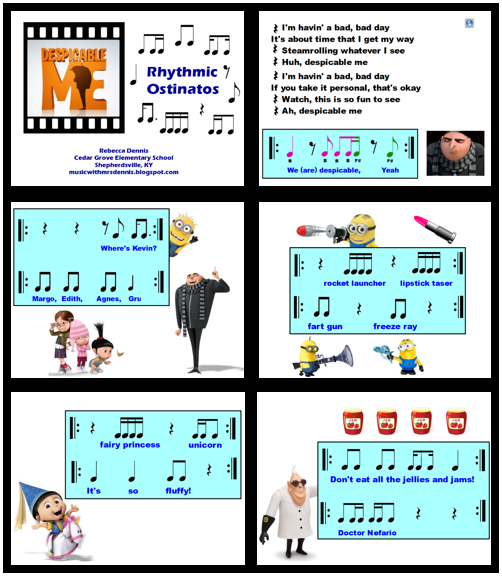
My student teacher and I recently designed two lessons inspired by the Despicable Me movies. Both flipcharts are available for free download on Promethean Planet.

The first lesson focused on rhythmic ostinatos and complementary rhythms. It also finished a unit which had introduced sixteenth notes to fifth graders. We had a few students playing an ostinato on Bass Boomwhackers to accompany the chorus of "Despicable Me" (the title theme for the first movie). The rest of the class was assigned rhythmic ostinatos performed in pairs as complementary rhythms. You could add instrument sound effects for the rhythms, but we added body percussion. Unfortunately, I did not think to take a video of this lesson. But, the flipchart is now uploaded to Promethean Planet and is available for free download! The slides of the flipchart can be seen in the collage below.


The next lesson reviewed harmony and introduced chord building. Students learned how to build chords by alternating letters and stacking alternating pitches on the staff. We used Boomwhackers to play chords along with Pharrell's "Happy" from Despicable Me 2 (Oscar Nominee 2014!) The students also learned about call and response and chorus/verse structure. The flipchart is available for free download on Promethean Planet. Images from the flipchart can be seen in the collage below.


I also have a video of a class performing Boomwhackers for this lesson. It is far from perfect and my dancing is pretty embarrassing, but I will share it anyway! Please, don't judge! lol


I hope your students enjoy these lessons as much as mine did!

Friday, December 13, 2013

Music Centers

During the week of Thanksgiving Break, I didn't want to start a lesson or unit when I wouldn't see all the classes of the week. So, we experimented with music centers. I have 50 minute classes, so I chose 4 centers. It took about 10 minutes to explain the games and then students travelled in groups and had about 10 minutes at each center. They seemed to enjoy them, so I will definitely try this again later in the year with all the classes. Once the kids have tried the centers, they would be great for emergency sub plans!

Giant Staff Twister


In a previous post, I shared the activity where we did relay races with our giant floor staff. Jen Fink, at pianamation.com, has used the floor staff to play a modified game of Twister. She created cards you can use for the game, one deck contains body parts (hands and feet) and one deck contains lines and spaces and they are available to print from her blog. We decided to make the game like traditional Twister and create spinners. The spinners are available on my teacher-pay-teacher store.


Boomwhacker Center


In the Boomwhacker center, students practiced note reading. They took turns playing songs from the book "Whack-a-Doodle-Doo!" I have 2 copies of this very affordable book ($5.95 from westmusic.com) One student would attempt to play a song. The next student in line would be able to flip through the extra book to select the song they would like to perform for their turn. This book includes colored notation made it easy for the older students to perform the songs. The younger students needed assistance, so my student teacher positioned herself at that center.

Connect 4 Composition

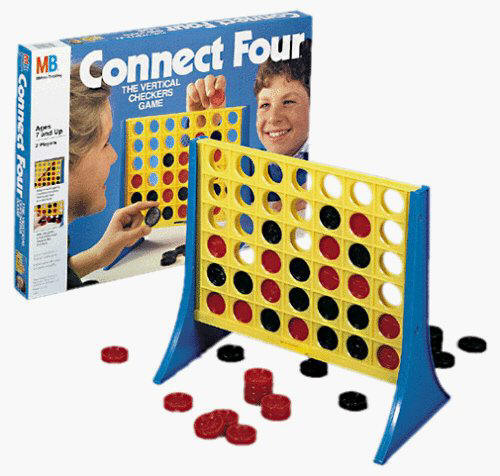
The younger grades used a Connect 4 game for rhythmic composition. They took turns filling the bottom row with checkers.  The red checkers represented a sound and the black checkers represented a rest. The students performed the rhythms on lollipop drums. Unfortunately, I did not get a picture of the younger students in action at this center.
For the older students, I used a more advanced game, Connect 4 x 4, with 4 different colors--red, yellow, green, and blue. I selected a few unpitched percussion instruments and the students would decide which instruments would play for each color. The students took turns creating new compositions and experimenting with different timbres at the same time. This version of the game has full and empty checkers. I forsee these representing quarter notes and half notes at some point in the future. (Connect 4 x 4 can be found on walmart.com for $19.86)


Technology Center

The technology center used the Interactive whiteboard and the iPad. On the Activboard, the students took turns on a game from nyphilkids.org. The game pictured below is "Music Match Instruments" which is a memory-type card game. I have also collected links to many other music sites and they can be found at this link.


They students could also play a music game on the iPad. Make sure you check out a previous post sharing 110 free music apps for the iPad. Kindergarten and 1st grade were playing rhythms on Monkey Drum. 2nd and 3rd grade were reading rhythms on Rhythm Cat. 4th and 5th grade were testing out a new app Cookie Beats. Look for a review of this app coming soon!


I have dedicated an entire Pinterest board to 
Check it out for more great ideas!


Wednesday, July 25, 2012

Getting Ready . . .

Today I went back to school to begin getting my classroom ready. I had a little helper. My 2 yr old daughter seemed to love the Boomwhackers and Lollipop drums the most.


Sure, it looks like a mess, but my Boomwhacker organization system made it easy for my toddler to clean up her own mess. I placed one of each color in the correct slots and she matched the rest of the colors. I love making some kind of game out of clean-up tasks. (If you missed the post on Boomwhacker Storage, click here.) 


Thanks to my Instrument Storage Labels, she was also able to return the lollipop drums to their home. (If you missed the original post about Organizing Instruments, click here.)


This was the true test at whether an organized storage system is worth the time and effort. The answer is: YES! If a 2 year old can clean up after herself, just think how easy it should be for school-age children!

When my room is finished, I will be posting more pictures of my classroom environment.

Monday, June 11, 2012

We Love Phil Tulga!

My students and I love the website of Phil Tulga! If you are not already familiar with his site, here is a brief introduction.
He has many music games that integrate language arts, math, and science. He also has several different instructions to make homemade instruments.


Here are a few of our favorite games:

Musical Fraction Bars


This activity describes how to measure and make your own musical tubes similar to Boomwhackers. The interactive game allows students to compose with the colored bars and even play back their music in various tempi. The students can create harmony by stacking colored tubes. The colors of these tubes match the colors of the Boomwhackers; so, after composing a song, students can use Boomwhackers to play it themselves. There are also several preloaded songs students can choose to start with and then alter to make a variation. The students can create a song and then email it to a friend, parent, or teacher! This game provides endless fun!

Cucumber Pickle Machine


My students LOVE the Cucumber Pickle Machine. I don't know if it is the silly face made by the machine or just their love of pickles, but they could spend the entire class playing this game if I would let them! This game explores mixed meter with the 3-syllable word "cucumber" and the 2-syllable word "pickle". The white cucumbers and pickles are silences. Phil has also listed several popular meters for the students to create on the machine: rhuma, flamenco, clave, heartbeat, conga, short bell, fanga, samba, and the most popular "Mission Impossible."

Unifix Drum Machine


This game allows students to compose layered rhythms. The ostinatos repeat on a loop but you can also change the tempo. You can control which part you hear by turning each on or off by one easy click. You change the color of each square by clicking the square: blue=low, red=high, yellow=silence. There are several patterns available for the students to choose from or they can start from scratch and create their own. The students can see how there are 4 cubes grouped together. This can represent 4 beats in a measure or 4 subdivisions of the beat. After exploring this game on the interactive white board, give the students real Unifix cubes to create their own rhythms! 

There are many more activities available on Phil Tulga's site! Go, explore, and share your favorite Phil Tulga activity!

Thursday, May 17, 2012

Boomwhacker Storage

I have recently seen a post floating around Pinterest showing a way to organize your Boomwhackers. Rainbows Within Reach shows a cardboard file stacker turned on its backside with cardboard dividers inserted into the slots to separate each boomwhacker. Although she has many great ideas for organization around the classroom, I kept scratching my head when I saw this picture. (Please note that this system does not belong to Rainbows Within Reach. She took the picture when she was visiting another elementary music classroom.)

I'm all about organization; I have an entire Pinboard devoted to it. But when I look at a post on organization, the first thing I ask myself is, "how long would it take someone to create that?" One must evaluate their system to make sure they're not wasting their time with details that are not necessary. When I saw Rainbow's picture of storage system, I didn't understand why each Boomwhacker needed it's own little cubbie hole. I just thought of the time it took to cut the cardboard dividers and to get them to fit just right snug in their place without moving around while the children are getting the Boomwhackers in and out. The individual cubbies are not necessary. Also, some of the smallest Boomwhackers looked difficult to reach because the cardboard was taller than the Boomwhacker. (To solve this, the teacher could put something in the bottom of the slot so the Boomwhacker does not fall all the way down. Something quick and easy could be wadded up newspaper.)

Here is a picture of my Boomwhacker storage system:


Each pitch has it's own slot, but there is really no need for each Boomwhacker to have their own cubbie space. I have stored my Boomwhackers this way for 6 years and the cardboard boxes are still in pristine condition. It does not require any maintenance. In the picture below, you can see that I reused boxes that came from brand new sets of hand drums. The smallest frame drum boxes are shorter so it is easy to reach even high do! If you were not fortunate enough to have purchased a brand new set of hand drums, any set of narrow boxes would do. You could cut the height to the correct size for the shortest Boomwhackers. (I also like organizational systems that you can make for free! I always think twice about something before I throw it away. I also have a pinboard devoted to repurposing.) 


I do not have any of the long lower octave Boomwhackers, but I do have some Octavator Caps that make the pitches lower. I store them in a plastic index file and just stick the box in the open space near the upper octave. I have a set of 8 and they fit perfectly. This index card box was something I had laying around, so no money was wasted purchasing something new.


I keep my box of Boomwhackers in the bottom of my storage cabinet. When I need them for a lesson, it is easy to just slide the box out and put it back out of the way when finished.


I especially like the fact that students can easily put the Boomwhackers away without teacher assistance. During clean-up time, I call only one pitch/color at a time and rarely do I have a kid put their Boomwhacker in the wrong slot. Also, with this arrangement, the students can visually see the progression from low to high (long to short). They almost always make the connection to how the xylophones are arranged. This is the system that works in my classroom. I hope someone else finds it useful as well.